
No matter what stage you’re at with your writing – whether still at the first draft, or with dozens of books to your name – there’s always something new to learn about the craft of writing.

Besides writing, I also work as a freelance editor. (In fact, for quite a while now the editing has come first, and writing has taken a back seat.) One of the options I offer new clients is a sample edit. This consists of a full copy-edit of the first 5,000 words of a novel, plus feedback on the synopsis.
Offering a sample edit gives me the opportunity to find out just how much work a manuscript might need. It also gives the customer the chance to see how I work, and to decide if they’d be happy to continue working with me. (So far, they all have. Phew!)
There are times when I can see a writer knows how to write. But do they know how to tell a story? That’s a different thing – but all is not lost, because the craft of telling a story can be learned.
If I feel a novel still needs more work before it’s ready for editing, I recommend one – sometimes all three – of my favourite books on fiction writing. There are thousands of books out there, and every writer has their own particular favourite, but these are the three I’ve found most useful.
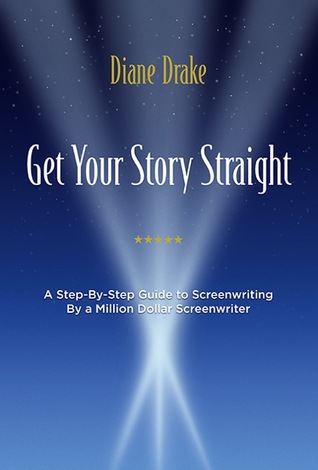
 Get Your Story Straight, by Diane Drake
In a reversal of what generally happens, I was recommended this book by one of my clients. This is a client I’ve been working with on a screenplay. I edit novels rather than scripts, but my client wanted someone to help her with her grammar, spelling, etc. She liked my feedback on her characters and the overall story, so she’s continued to work with me.
Anyway, to cut a long story short (which is something I advise when I’m editing :) ), I bought this book because I was interested in how stories for screen are structured, and how that differs from novel writing. I read the book from cover to cover. I found it excellent. The pointers on story structure were explained in a way that is easily grasped (unlike some books on writing I’ve read), and these particular chapters changed the way I’m working on my present novel.
I knew I was going to like this book as soon as I noticed there were three chapters (three!) covering the basic question ‘what is your story about?’ This is a question I put back to clients on a regular basis. If you don’t have a clear idea what your story is about, your novel/screenplay will just be a set of meandering scenes.
I particularly liked the analysis of famous scripts and what it is about them that makes them great. The author analyses a range of films, from Iron Man to Roman Holiday. This book is useful for novel writers and screenwriters alike. (If you’re writing a screenplay, you might also want to check out Diane Drake’s website, where she offers courses and individual feedback.)
 On Writing Romance, by Leigh Michaels
I recommend this book, not just to romance writers, but to people writing any genre of fiction. I’ve found it invaluable, especially when it comes to creating the all-important conflict that drives a story.
Here are two Amazon reviews that sum up exactly why I recommend this book:
‘The subtitle of this book is ‘How to Craft a Novel that Sells’ and that’s exactly what it shows you. 90% of the advice and techniques can be applied to ANY genre of fiction.
It has a brilliant chapter on plotting, put in terms that can be easily understood. The author covers dialogue, even the differences between male and female speech patterns; how to create suspense, the difference between scenes and chapters and how to start and finish, keeping the reader interested as well as how to create characters and introduce romantic conflict, and much more.
All-in-all this is a very useful tool that teaches the basics in a way that is easy to read and easily understood. I wish I’d read this book first.’
‘The chapter on internal and external conflicts is brilliant (I agree!) making it clear why you need both and how to develop ones that are complementary to each other and really fire up your plot.’
Romance novels are all about the romantic conflict. What is it that’s keeping two people apart, even though they are made for one another? This book goes into this in depth and is well worth buying just for this chapter alone.
*UPDATE* It appears this book may be out of print at the moment. If you’re looking for a copy, you may have to buy used. Please drop me a comment if you manage to get hold of a new copy.
 Self-Editing for Fiction Writers, by Renni Browne and Dave King
This book is probably most useful for when you’ve actually finished your story and you are in the process of polishing it. Once you’ve got the first draft down, you can go back and address some of the issues the authors cover here.
I particularly like the chapter on show and tell. Again, ‘show don’t tell’ is a comment I use often in the margins of manuscripts I’m editing. That, and resist the urge to explain, or RUE, as they have it in this book. The authors give plenty of examples of passages that lack life, to help you see where your own might need some sparkle. (I also have some examples of ‘show vs tell’ in this previous post.) And again, don’t worry unduly about this when writing your first draft. It’s important to get the story down, and this is an area you can generally come back to and rework.
Besides ‘show and tell’, the book also covers areas like point of view and head-hopping, repetition, and – one of my own weaknesses – the ‘beats’ used in dialogue. My own characters tend to be terrible fidgets during dialogue, forever raising their heads or shrugging, or fiddling with the cutlery. I usually have a battle on to make sure their ‘tics’ don’t take over a conversation.
Their are plenty of examples in the book, and even some exercises – but if you want to have a go at applying their advice, there’s nothing better than going through your own manuscript.
*
These are the three books I recommend most often. If you do buy them and find them useful – or if you’ve already read them – I’d love to know what you think.
And If you already have a favourite book on the craft of writing, I’d love to hear your recommendation. You can never have too many writing books!


 Helena Fairfax
Leave a Reply