

If you’ve been following my blog, you’ll know this summer I’m running a series of posts on books set in Yorkshire, showcasing the county’s vast cultural heritage and variety.
Last month I chose novels set in Bradford, the UK’s City of Culture 2025. This month, in complete contrast, I’ve chosen books set in Yorkshire’s ancient abbeys.

There are several magnificent ruined abbeys across Yorkshire, from Whitby Abbey on the coast, to Bolton Abbey near Ilkley, and Kirkstall Abbey in Leeds, some of them dating as far back as the twelfth century.
If you know your history, you’ll know the abbeys were forcibly closed during the Dissolution of the Monasteries under Henry VIII. The king had fallen out with the Catholic Church in Rome over their refusal to annul his marriage to Catherine of Aragon and allow him to marry Anne Boleyn. The forced closure and destruction of almost one thousand monasteries was one of the most revolutionary acts in this country’s history and the scars are still visible today in their magnificent ruins.
Hilary Mantel wrote about the closure of the monasteries in her brilliant Wolf Hall trilogy. Mantel paints a sympathetic picture of Thomas Cromwell, and in her novel he appears to stand for enlightenment and against the church’s corruption.

Image by Tim Hill from Pixabay
Some experts disagree with this view of the Dissolution, saying Cromwell was a very unpopular figure and that the monasteries provided an important role in the community. (Hilary Mantel tells a great tale but ruined abbeys tell a different story)
For an alternative view to Mantel’s, and to see events through the eyes of the ordinary people, I highly recommend HFM Prescott’s novel The Man on a Donkey. This novel tells the tale of Robert Aske and the Pilgrimage of Grace, a rebellion against the Dissolution that was put down.

The blurb calls it ‘a sweeping, immersive historical novel that invites the reader to inhabit Tudor history as it unfolds: Henry VIII’s divorce from Catherine of Aragon; Robert Aske’s rebels fighting the Dissolution of the Monasteries; the machinations of Cardinal Wolsey and Anne Boleyn. It is, quite simply, one of the finest historical novels ever written.’
If you do give this novel a try, it takes some getting into, but I read it as a teenager and found it gripping. Some scenes still stay in my mind, and Hilary Mantel called it ‘a classic of historical fiction’.

You’ll see from my photos that the ruins of these Yorkshire abbeys are magnificent.
Bram Stoker was famously inspired to write Dracula after a visit to Whitby Abbey, which provides the setting for parts of the novel.

The architecture of the ruined abbeys inspired a wealth of Gothic literature in the eighteenth and nineteenth centuries. Jane Austen famously satirised some of the more lurid novels in Northanger Abbey, whose heroine loves to scare herself by imagining all sorts of dark deeds.

Image by PublicDomainPictures from Pixabay
Even today, it seems Yorkshire’s ruined abbeys inspire mainly stories of violence and murder most foul! I wasn’t able to find any romantic fiction when putting together this list of novels set in Yorkshire’s abbeys – but if anyone knows of a romance novel that uses one of these fabulous abbeys as a setting, please do let me know!
With that said, here are four more novels set in Yorkshire abbeys:
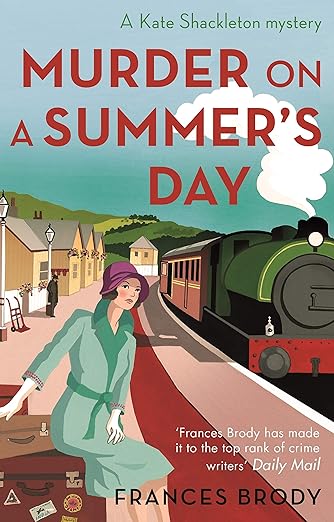
Murder on a Summer’s Day, by Frances Brody
A Maharajah on the Moors
When the India Office seek help in finding Maharajah Narayan, last seen hunting on the Bolton Abbey estate, they call upon the expertise of renowned PI Kate Shackleton to investigate.
A Priceless Jewel
A missing person’s case turns to murder when, shot through the heart, it’s clear to Kate that Narayan’s body has not been in the woods overnight. Who brought it here, and from where? And what has happened to the hugely valuable diamond that was in the Maharajah’s possession?
An inexplicable murder . . .
As Kate digs deeper, she soon discovers that vengeance takes many forms. Was the Maharajah’s sacrilegious act of shooting a white doe to blame? Or are growing rumours of a political motive too powerful for Kate to discount?
One thing Kate is sure of: her own skills and insights. Qualities that she is sure will help her unravel a mysterious murder on that fateful summer’s day . . .
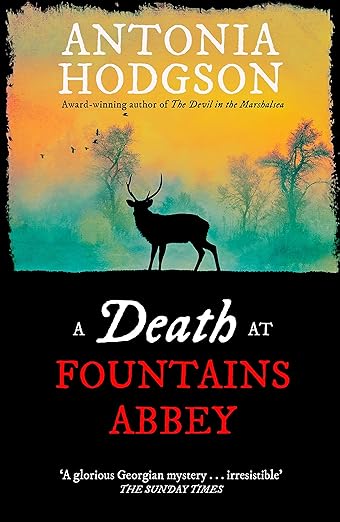
A Death at Fountains Abbey, by Antonia Hodgson
‘You will burn.’
Late spring, 1728. Fresh from his escape from the gallows, Thomas Hawkins has arrived in Yorkshire with his ward, Sam Fleet. But death still has a hand upon his shoulder, even in such idyllic surroundings.
John Aislabie, Tom’s reluctant host, is being tormented by anonymous letters threatening murder. A disgraced politician, Aislabie certainly has plenty of enemies. But, trapped in a house haunted by old tragedies, Tom begins to suspect that the danger lies much closer to home. Someone is playing a subtle and deadly game of revenge, years in the planning. And now Tom is standing in their way…

The Constant Lovers, by Chris Nickson
A tale of greed, ambition and thwarted love in eighteenth-century Leeds
July, 1732. On a hot summer morning, Richard Nottingham, Constable of Leeds, is called out when a young woman is found stabbed to death among the ruins of Kirkstall Abbey. In her pocket is a love note: “Soon we’ll be together and our hearts can sing loud, my love. W.” What happened to the maid who accompanied her mistress on her final, fatal journey? Who is the mysteious ‘W’ who signed the note? Nottingham must delve into the dark secrets of the rich and influential to uncover the truth.

Jonathan Strange and Mr Norrell, by Susanna Clark
Fountains Abbey and Kirkstall Abbey were used as locations in the BBC TV adaptation of this novel, which is set mainly in York
1806. England is beleaguered by the long war, and centuries have passed since magicians faded from view. But one remains: the reclusive Mr Norrell. Proceeding to London, he raises a woman from the dead and summons an army of ghostly ships to terrify the French.
Yet the cautious Norrell is challenged by the emergence of another magician. Young, handsome and daring, Jonathan Strange is his very antithesis. So begins a dangerous battle between these two great men – which overwhelms that between England and France. And soon their own secret dabblings with the dark arts are going to cause more trouble than they can imagine.
*
I hope you enjoyed this month’s stop on my literary tour of Yorkshire! If you have any recommendations for novels set around Yorkshire’s abbeys, please do let me know in the comments.


 Helena Fairfax
Leave a Reply