

Another month and another Authors’ Round Robin! And this month the topic is…
How do you encourage children to read?
When I was a child I read voraciously. To be honest, I probably read a bit too much. You may think that’s not possible, but there is a whole big world for children to explore and discover, and I often had my nose pressed to a book.

When my own children were young, I didn’t worry too much about encouraging them to read. As it turned out, they all loved reading as children, too, and our house was full of shelves and shelves of books as they grew up. This leads me to my first tip…
Tip One for encouraging children to read:
Love reading yourself
There is a saying that it doesn’t matter how often you tell children what they should do, they’ll only copy what you do yourself. If children notice you spend a lot of your free time reading, they will want to know what’s so good about books. If you talk with them as they’re growing up about the books and characters you love, they’ll see reading as not just something for nerds, but something grown-ups get enthusiastic about and swept away by.
A study by the National Literacy Trust found: ‘Parents and the home environment are essential to the early teaching of reading and the fostering of a love of reading.’
If you’re a parent and you don’t love reading yourself it’s more difficult to make your children enthusiastic about it. Many adults say they just don’t have time to read, but there is always time. You can put down your phone and read a book on the bus, waiting at the doctor’s or waiting at the school gates, or while eating your dinner. (Oops – not that last one. That’s one my children shouldn’t have copied :) ) Reading is a habit, and to get hooked, you absolutely don’t have to read anything fancy. Pick up a bestselling book – something page-turning like The Da Vinci Code, by Dan Brown, or Lace, by Shirley Conran, or the first Harry Potter book, or The Girl on the Train, by Paula Hawkins. I’ve read all these books – these authors know how to tell a damn good story and keep a reader glued to the page. If your children see you engrossed, they’ll think reading is something special – and it is!
Tip Two: encourage babies and toddlers to love books
When my children were babies I was amazed how much enjoyment they could get from a 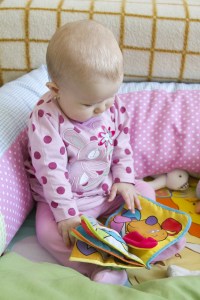 book at a very young age indeed. Tiny babies recognise the colours black and white best, and there is a lovely article here by the Scottish Books Trust on why black and white books are perfect for them. I’ve seen babies lying fascinated, head turned, gazing for ages at the images in a black and white book.
Babies as young as six months can follow a book with colourful pictures and it’s surprising how quickly they learn that the page needs turning, and they’ll attempt to do it themselves.
Have patience
Toddlers love to hear the same story over and over again, which is great for them, but hard work for parents. I used to have every single word and picture of Where the Wild Things Are engraved on my eye-balls, and, let’s be honest, sometimes when I read it for the twentieth time in a day, it wasn’t easy to make reading fun. But parents…stay strong! Imagine the scene in a few years’ time when your child can read by himself and is sitting quietly occupied while you read your own book! Brilliant! All those years of Max and his interminable wolf suit will have paid off.
Seriously, though, one reason toddlers love to have you read to them is because sitting on your knee with a book is a special time for them when they have your undivided attention, and they also get to rest, take time out from the stresses of being a toddler and be entertained. Books rule again.
Tip Three: mix reading books with their own interests
When children get to primary school, reading can sometimes seem like a chore – just another lesson to be learned before the school day is over, when at last they can have fun doing something more interesting. Smaller schoolchildren still like to be read a bedtime story, though – 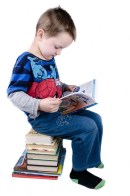 mine used to make it an excuse to stay up a bit longer. Even if you’re worn out and still have the washing-up to do and next day’s uniform to iron, it’s worth taking half an hour to sit with them and read. There will always be washing-up, but believe me, those evenings of bedtime reading won’t last. Make the most of them, for both your sakes.
Older primary school children might start thinking bedtime stories are for wusses. If they’ve gone off the idea of reading altogether, getting books that match their interests can help – books of their favourite TV programme, for example (the Horrible History series is brilliant), or football annuals, or even plain old comics. Picking their own comic can be a treat, and at this age, all reading is good reading. There’s no point forcing classics on a child who isn’t interested. Reading has to be fun! This leads to…
Tip four: let children decide for themselves what they want to read
Once children become teenagers, they almost certainly won’t want to read what you think is a

good book. They’ll want to make their own choices. That doesn’t matter, as long as they choose to read something. I’ll admit, buying books regularly for your children at this age can be expensive, but this is the time when libraries come into their own. There are some amazing YA books; nowadays most libraries have a dedicated section for teenagers and young adults with a brilliant array of choice. I’ve read some wonderful graphic novels, too, with fabulous illustrations and thought-provoking themes. If you can afford the occasional book token, let your children browse round a bookshop and choose whatever they like. With so many stunning books for teenagers nowadays, hopefully it will feel like a special treat.
But don’t agonise too much about it. In Jane Austen’s Northanger Abbey, Henry Tilney says, ‘The person, be it gentleman or lady, who has not pleasure in a good novel, must be intolerably stupid.’
Henry Tilney was a bit of a know-it-all, and I don’t think what he says is true. Don’t worry too much about getting your children to read. Nobody wants to read a book under pressure, and children can have plenty of other interests. I know lots of adults who don’t read a lot, but none of them are ‘intolerably stupid’. They have other interests – playing and listening to music, painting and art, playing sport, sewing and needlework, gardening, cooking, astronomy, rock-climbing.
I can’t think of anyone I know, though, who, even if they don’t read much, hasn’t read at least one book that they loved. If your children grow up to understand that books can open up amazing worlds, even if they don’t read much, they’ll always know that those worlds are out there for them.
* * *
Did you love reading as a child? Did you feel pressured to read? If you have children of your own, do/did they read a lot, and if so, how did you encourage them?
If you have any comments at all on this subject, I’d love to hear them!
And since this is a Round Robin, you can read the other authors’ blog posts on this subject by clicking on the links below. Hope you can drop in and check them out!
Skye Taylor http://www.skye-writer.com/blogging_by_the_sea
Victoria Chatham http://www.victoriachatham.com
Dr. Bob Rich https://wp.me/p3Xihq-1ly
Connie Vines http://mizging.blogspot.com/
Anne de Gruchy https://annedegruchy.co.uk/category/blog/
A.J. Maguire http://ajmaguire.wordpress.com/
Anne Stenhouse http://annestenhousenovelist.wordpress.com
Helena Fairfax http://www.helenafairfax.com/blog
Fiona McGier http://www.fionamcgier.com/
Rhobin L Courtright http://www.rhobinleecourtright.com


 Helena Fairfax
Leave a Reply