

Another month, and another authors’ Round Robin! This month author Skye Taylor has set us a thought-provoking topic…

How do you choose the right career for your characters?
When I first started writing, I wrote what I knew. I’ve worked in a textile mill in Yorkshire. I also spent time as a student in Lyon, a city I grew to love. I combined these two settings in my first novel, The Silk Romance.
My heroine, Sophie, is a student who goes to work in a silk mill in Lyon, where she discovers the owner is a man she’s met before (and that’s where the story takes over from reality…!)

Why does your character’s career matter?
It wasn’t until after I’d written this novel that I began to reflect on the importance of the career choices I’d made for my main characters, and to think much more deeply about them.
I write romantic fiction. One of the areas I think more deeply about now, in my own writing and when editing romance novels for others, is:
Women, careers and power balance
The days when the heroines of romance stayed at home or worked as secretaries until they married are thankfully gone. (For a taster of these novels, try my review of a 1930s’ Mills & Boon romance. Reading In the Name of Love was an eye-opener!)

In my silk-mill novel, the hero, Jean-Luc, has all the power as a wealthy sporting hero, while Sophie is penniless and has nothing. The ‘billionaire boss’ is still a massively popular trope, as this M&B collection shows.
Nowadays I think very hard before choosing my protagonists’ careers, and try to give an equal balance. An equal power balance generally means equal money, and equal money generally means both hero and heroine have careers that pay a similar wage.
In my novel Felicity at the Cross Hotel, I deliberately tried to reverse the balance of power, so that in the opening the heroine holds all the money cards. This leads to…
Your character’s career, conflict, and plot opportunities
All stories revolve around conflict. With some stories the conflict comes as a direct result of the career. Many crime novels revolve around a detective’s career, and it’s the crime that provides the plot opportunities.
In romance novels, the conflict is character driven, rather than plot driven. (That is, the characters’ conflicting goals or beliefs prevent them getting together emotionally until the end of the novel.) Quite often their careers can be that source of conflict.
A couple of examples:

In the brilliant The Hating Game, by Sally Thorn, the hero and heroine work at a publisher’s and are locked in a bitter struggle for the same promotion.

In Emily Henry’s Book Lovers, the hero and heroine are publisher and agent and also rivals. (I loved this novel because it deliberately subverts the small-town trope, in a really funny way, as the heroine loves living the city.)
Your characters’ careers and their personalities
Besides dictating how much money your character earns, their career will influence their world view – and they’ll have chosen a particular job because of their own personality and background. A character who works in home care will have a very different personality to one who works in stocks and shares.
What has made your own character choose their field? What do they enjoy about it? What do they dislike? How does this fit their personality? And how does their job affect the events of the story?
Here are two examples from books I’ve been reading and enjoying recently of how a character’s job informs their personality and affects the plot:

In Claire Keegan’s Small Things Like These, Bill Furlong owns a coal and timber merchant’s and he employs staff. His job shows he’s done well for himself, and his staff respect him. He works hard and earns a solid living for his family, which shows he’s a decent guy. He also delivers locally, and it’s the local deliveries that advance the plot, as he gets to know everyone in the neighbourhood.

In Francesca Segal’s Welcome to Glorious Tuga, Charlotte Walker is an academic studying tortoises on a tiny remote island. She thinks it’s the perfect job, as she doesn’t like socialising and prefers her own company. What she doesn’t realise is that the island has a strong community where everyone knows everyone. Gradually, she’s forced to overcome her shyness and reserve.
Careers and research
What if the perfect career for your hero and/or heroine is one you know nothing about?
Some tips for whittling down the wealth of information online:

- LinkedIn can be a great starting point. People often share experiences on this site, and also links to industry blog posts
- I’ve found it helps to join social media groups, such as the ones of Facebook. Reddit is also a mine of info
- Check out the hashtags for your career on Insta/Threads/Bluesky/X
- Check out YouTube channels
- Look for podcasts focusing on the industry
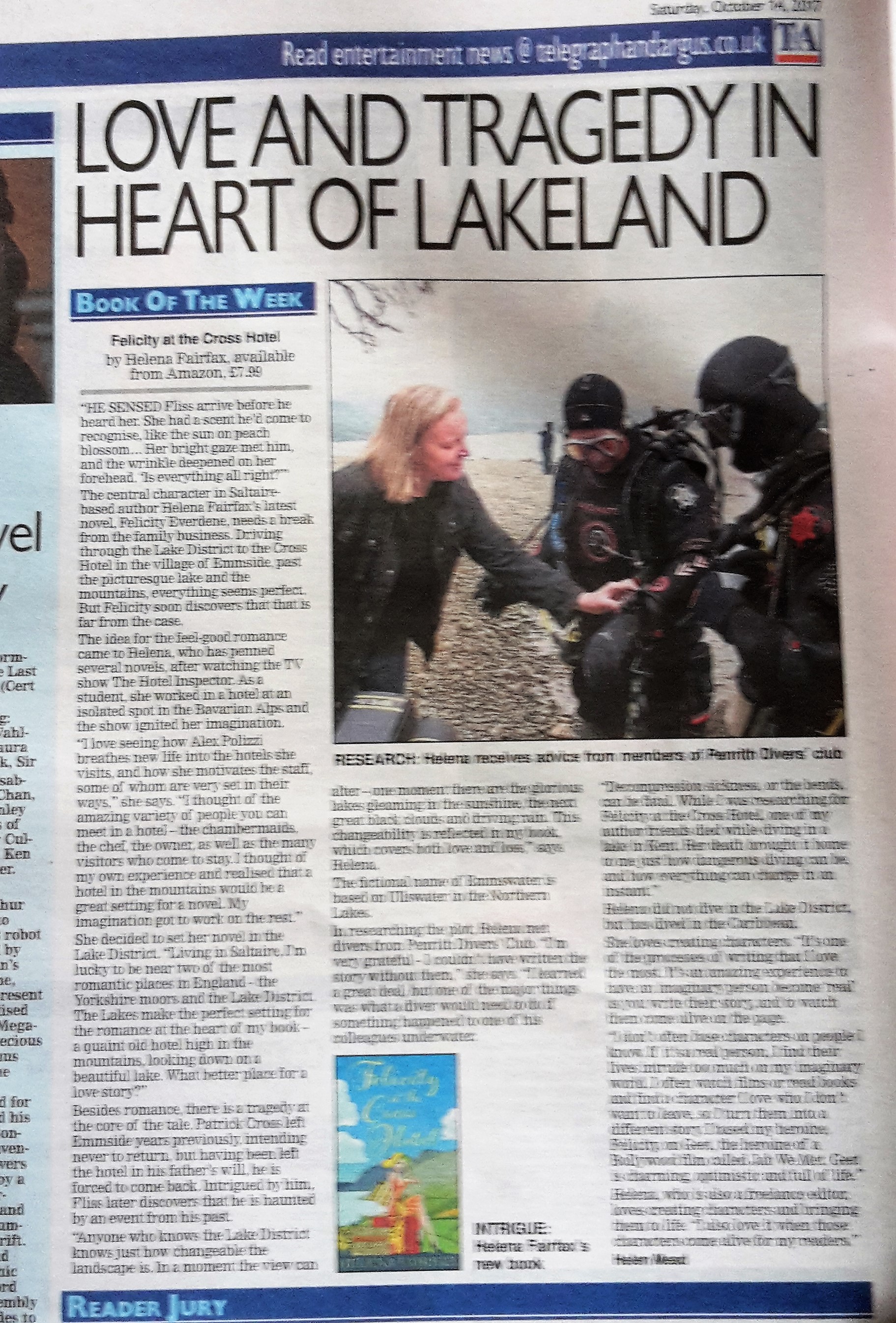
When I first started out writing I felt nervous about contacting people directly for help with research – especially as I write romantic fiction, the most looked-down-on of genres.
But for Felicity at the Cross Hotel, I struggled with a few of the details for my hero’s career. I found nothing would help but to contact a group of freshwater divers in the Lake District. The group were massively helpful, and the men were particularly enthusiastic about being the models for a romantic hero :) We’ve stayed friends, and I even got a write-up in the local press.
So if you’re struggling to fill in the background to your character’s career, don’t be afraid to reach out. You never know where it may lead!
*
If you’re a writer, how do you go about choosing your characters’ careers? If you’re a reader, are there any careers that would particularly draw you to a novel?
I’m looking forward to reading the other authors’ take on this topic. Please click on the links below for my fellow authors in the Round Robin.
Anne Stenhouse http://annestenhousenovelist.wordpress.com
Victoria Chatham http://www.victoriachatham.com
Connie Vines http://mizging.blogspot.com/
Dr. Bob Rich https://wp.me/p3Xihq-3m7
Diane Bator https://escapewithawriter.wordpress.com/
Marci Baun http://www.marcibaun.com/blog/
Skye Taylor http://www.skye-writer.com/blogging_by_the_sea


 Helena Fairfax
Leave a Reply